2026 "NEED TO KNOW" SMART PAPER™ SERIES
Sustainable End-of-Life
Solutions for Produce Packaging
Fresh produce has a packaging problem, but it’s not the one most people think.
For growers, shippers, retailers, and foodservice buyers, packaging is not optional. It protects fragile products, extends shelf life, reduces shrink, improves food safety, supports merchandising, and helps brands compete at the point of sale.
The real problem is what happens after the package has done its job.
For years, the packaging conversation has been dominated by two preferred answers: recyclable or compostable. Both have value. Neither is enough on its own.
Smart Plastic has a solution.
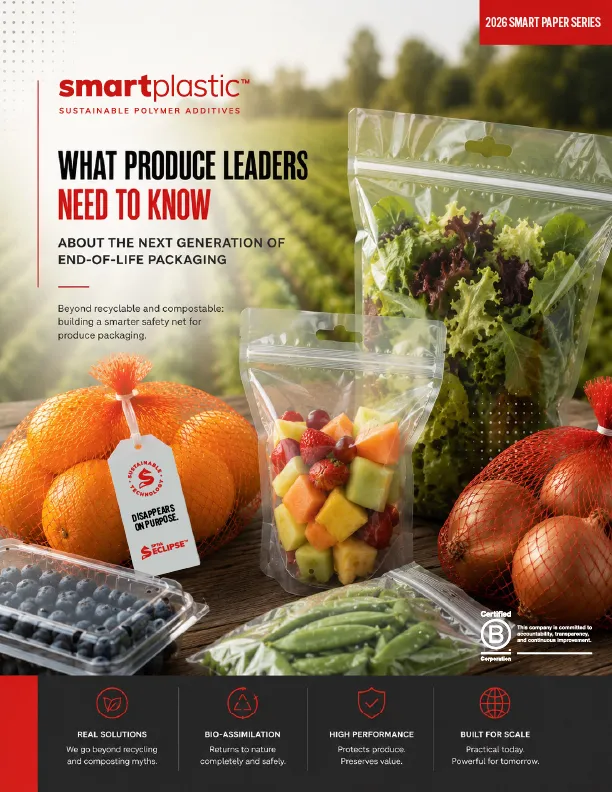
Download your personal copy of “What Produce Leaders Need to Know About the Next Generation of End-of-Life Packaging.”
THE SYSTEM GAP
Recyclable is not the Same
as Recycled
Packaging is not the enemy. Packaging without an end-of-life plan is.
Consumers often see a bag of grapes, a wrapped cucumber, a clamshell of berries, or a citrus net and think first about waste.
Produce leaders see something more complex: a package that has to protect a living, perishable product from damage,
moisture loss, contamination, spoilage, mishandling, and time.
Fresh produce is one of the most demanding categories in food. It bruises. It dehydrates. It breathes. It travels long distances through cold chains, warehouses, trucks, retail backrooms, and store displays before reaching a consumer's refrigerator.
The answer is not simply less packaging. The better answer is smarter packaging.
Data from the 2018 Environmental Protection Agency report below shows the problem:
PLASTIC CONTAINERS & PACKAGING
Recycled
13.6%
NOT RECOVERED
Landfilled
69%+
IS IT RECYCLABLE?
Recyclable
50%
Inside the Smart Produce Leader’s
Playbook
For most produce companies, the best way to evaluate next-generation end-of-life packaging is not to start with a full conversion. It is to start with a controlled pilot.
The next generation of produce packaging will not be judged only by what it is made from. It will be judged by what it protects, how it performs, what claims it can support, how it fits into real-world infrastructure, and what it leaves behind.
For produce leaders, that means the packaging conversation is changing. The question is no longer simply: “Is this recyclable?” The better question is:
“Does this package protect the product, fit the system, support the brand, and have a responsible end-of-life pathway in the real world?”
That is where the next wave of packaging innovation will happen. Not in slogans. Not in wishful infrastructure. Not in claims that collapse under scrutiny.
The future belongs to practical, tested, scalable materials that help produce brands protect freshness today and reduce pollution tomorrow.
Smart Plastic’s view is simple:
Packaging should not become a permanent problem after serving a temporary purpose. It should do its job. Then it should have a proven exit strategy.
STEP 01
Identify Your Highest-Opportunity Package
Start with a package that has high visibility, low practical recycling likelihood, and strong retailer relevance. Good candidates may include produce bags, netting, wraps, stretch film, or flexible films. Begin with a Pilot Program on one SKU.
STEP 02
Define Your Success Criteria
Success should include performance, operational, commercial, and sustainability criteria. Do not evaluate only the environmental claim.
STEP 03
Build the Evidence File
Before making claims, assemble the technical support. This should include product specifications, resin information, test data, recycling considerations, end-of-life evidence, migration or food-contact considerations where relevant, and claim substantiation.
STEP 04
Align with the Retailer Early
Do not surprise the buyer. Bring the retailer into the process with a disciplined explanation: what the package is, what it is not, what claims will be made, what evidence exists, and why the technology is appropriate for the specific format.
STEP 05
Launch with Careful Language
Avoid vague claims. Avoid overpromising. Avoid language that implies litter is acceptable. Use qualified, evidence-based statements and clear disposal guidance.
The goal is not to win a sustainability argument. The goal is to build confidence.
PRIORITY ACCESS : TECHNICAL PACKAGING REVIEW
Your Brand’s Competitive
Edge Starts with a Smarter Standard.
Ready to evaluate your produce packaging for next-generation end-of-life performance?
Smart Plastic Technologies helps growers, shippers, retailers, and packaging partners identify where SPTek ECLIPSE™-enabled materials may improve packaging sustainability without compromising product protection or operational efficiency.
To start a packaging review, please fill out the form at right to contact the experts at Smart Plastic Technologies for a no-obligation technical consult.
#ChangethePlastic #ChangethePlanet.
Secure 256-bit encryption